Measuring Event Success in 2026: Attendance, Engagement, and ROI
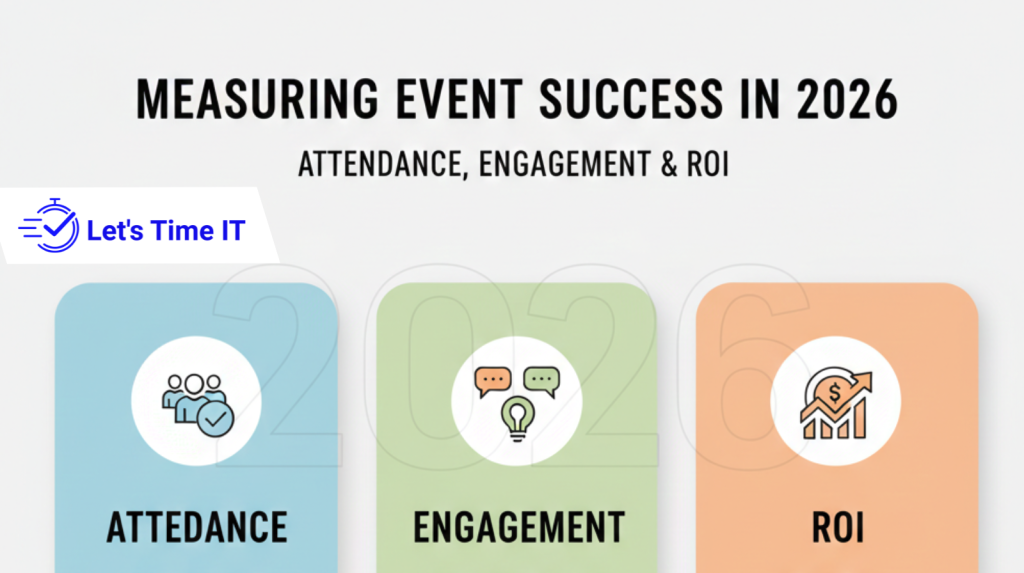
Measuring Event Success in 2026: Attendance, Engagement, and ROI
In 2026, event success is no longer defined by how many people registered, it’s defined by how well time, attention, and outcomes are managed. Event, conference, and webinar organizers are under pressure to prove real impact to stakeholders, sponsors, and leadership teams.
Whether you’re managing a timer for speakers, running a webinar timer, coordinating a timer for presenters, or managing a countdown timer for stage, the ability to measure attendance, engagement, and ROI depends heavily on how well your event runs on time. Tools like Let’s Time IT help teams bring structure and predictability to live and virtual events quietly working in the background while measurable results take center stage.
This guide breaks down how modern teams should measure event success in 2026 and how precise timing plays a bigger role than most organizers realize.
Why Event Measurement Looks Different in 2026
Audience expectations have shifted. Attention spans are shorter, hybrid events are the norm, and leadership expects data-backed outcomes, not vanity metrics.
Modern measurement now focuses on:
- Quality of attendance, not just volume
- Real engagement, not passive presence
- Business impact, not post-event surveys alone
Time discipline has become a hidden performance driver behind all three.
Metric 1: Attendance That Actually Matters
Registrations vs. Real Attendance
In 2026, successful teams separate:
- Registrations
- Logins
- Sustained attendance
Tracking who stays on time and through sessions gives a clearer signal of content relevance.
Session Drop-Off Analysis
Late starts and overruns directly impact attendance quality. Using a stage timer or timer for presentation helps sessions start and end predictably, improving session-to-session retention.
Time-Based Attendance Insights
Key questions to track:
- When do attendees join?
- When do they leave?
- Which sessions lose attention fastest?
Time consistency across sessions improves all three.
Metric 2: Engagement You Can Prove
Engagement Is Behavioral, Not Emotional
In 2026, engagement is measured through actions:
- Poll participation
- Q&A submissions
- Chat activity
- Session transitions
These behaviors increase when sessions are well-paced and visibly timed using a stagetimer or event timer.
Speaker Time Discipline = Higher Engagement
Overrunning speakers reduce Q&A time, the most measurable engagement signal. A visible countdown timer for events helps speakers self-regulate without awkward moderator interruptions.
Engagement Benchmarks to Track
- Engagement per minute (not per session)
- Interaction spikes during timed segments
- Drop-off during unstructured overruns
Metric 3: ROI That Leadership Understands
ROI Is No Longer Just Revenue
Modern event ROI includes:
- Pipeline influenced
- Product adoption
- Partner engagement
- Internal alignment
When sessions stay on schedule, attendees consume more content, increasing downstream value.
Time Efficiency as a Cost Multiplier
Every overrun session has a cost:
- Lost sponsor exposure
- Reduced networking time
- Lower session completion rates
Using a countdown timer for stage helps protect the event agenda and the ROI tied to it.
The Role of Timers in Event Measurement
Timers are no longer just operational tools, they are measurement enablers.
Why Timers Improve Measurable Outcomes
- Predictable agendas increase attendance retention
- Structured pacing improves engagement density
- Consistent timing improves post-event analytics accuracy
A remote-controlled countdown timer allows organizers to adjust timing in real time without disrupting speakers or attendees.
Using Let’s Time IT to Support Scalable Measurement
Let’s Time IT is designed for teams running multiple sessions, speakers, and formats at scale without adding friction.
Where Let’s Time IT Fits
- Conferences with parallel tracks
- Webinars with multiple presenters
- Executive meetings with strict time windows
Because timers are managed discreetly, speakers stay focused while organizers stay in control.
Adding Countdown Timers Across Event Platforms
Precise timing only works when it’s easy to deploy across tools your team already uses.
Countdown Timer for AddEvent & Add to Event Pages
Adding a countdown timer for addevent, add to event pages helps:
- Increase show-up rates
- Build urgency
- Set expectations before the event begins
Platform Coverage
Timers can be used across:
- Webinar platforms
- Live stages
- Speaker confidence monitors
- Backstage operator views
This consistency improves both experience and measurement accuracy.
Advanced Metrics Enabled by Better Timing
When timing is controlled, you unlock deeper insights:
- Session efficiency score (value per minute)
- Speaker performance comparison
- Engagement decay curves
- Agenda adherence rate
These metrics are becoming standard in 2026 reporting decks.
Common Measurement Mistakes to Avoid
- Measuring attendance without duration
- Ignoring session overruns
- Treating engagement as subjective
- Reviewing ROI without operational context
Most of these issues trace back to poor time visibility.
Measure What Time Makes Possible
In 2026, the best events success aren’t louder, they’re sharper. Attendance, engagement, and ROI improve when events respect time as a first-class metric.
By combining structured measurement frameworks with tools like Let’s Time IT, organizers can deliver events that run smoothly, scale effortlessly, and prove their value clearly long after the last session ends.